Commercial Roof Maintenance for Chicagoland Properties
For a commercial property manager, a roof problem can affect tenants, equipment and daily operations. A useful maintenance plan starts with an accurate record of the roof assembly and a clear process for responding to new concerns.
Build a roof record before a leak
Collect installation dates, warranty documents, roof plans, previous repair scopes and service photographs. Identify the roof system where records allow: membrane, insulation, drainage and attachment details can influence what work is appropriate. Do not select a repair material solely because it looks similar to an older patch.
Maintain a log of roof access by HVAC, communications and other service contractors. A record of what changed near the time a leak began can make an investigation more focused. Share access rules and coordinate any inspection with tenant operations.
Include drainage and penetrations
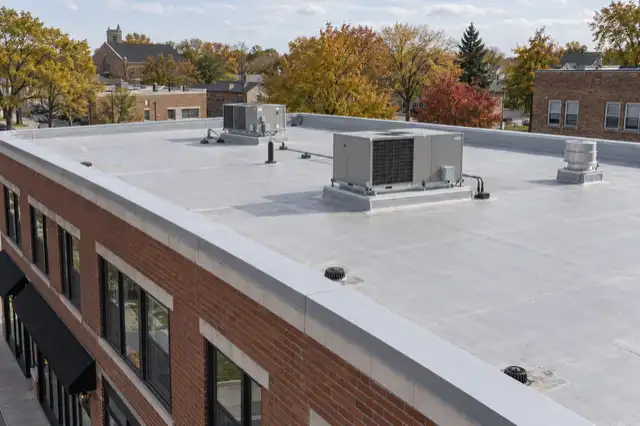
Drains, gutters, scuppers, seams, flashings, edges and equipment curbs deserve attention alongside the main roof surface. Ask the inspector to document debris, visible deterioration and areas where water appears to collect. The cause and significance of standing water depend on the assembly and drainage design; it should be evaluated rather than covered with an arbitrary coating.
Roof access should follow the site's safety procedures. Avoid sending untrained staff onto a wet, icy or unfamiliar roof to diagnose a leak.
Track interior symptoms precisely
Mark the location, date and conditions of each leak. Photograph interior symptoms and note nearby equipment or recent work. Water can travel within an assembly, so the point where it appears indoors does not necessarily identify the point where it entered.
Ask for the proposed diagnostic approach, what it can establish and whether further testing requires separate approval. Distinguish immediate leak management from permanent work and from a longer-term capital plan.
Evaluate repairs and replacement as complete scopes
Discuss the extent of deterioration, history of repairs, moisture concerns, drainage and compatibility with the existing system. Ask what each option leaves in place, how details are handled and what limitations remain. Plan access, tenant communication, noise, cleanup and equipment coordination before work begins.
If reflective roofing is being considered, evaluate the building and climate rather than relying on a generic savings promise. The Department of Energy notes that cool-roof performance depends on factors including climate, insulation and building use. There is no single energy-savings number that applies to every Chicagoland roof.
Create a property-specific next step
Affordable Roofing of America provides commercial roofing services. Request an assessment with the property address, roof concern and access requirements. Check our service coverage and call (708) 362-7500 to confirm availability.
Further reading: Department of Energy: Guidelines for Selecting Cool Roofs.
